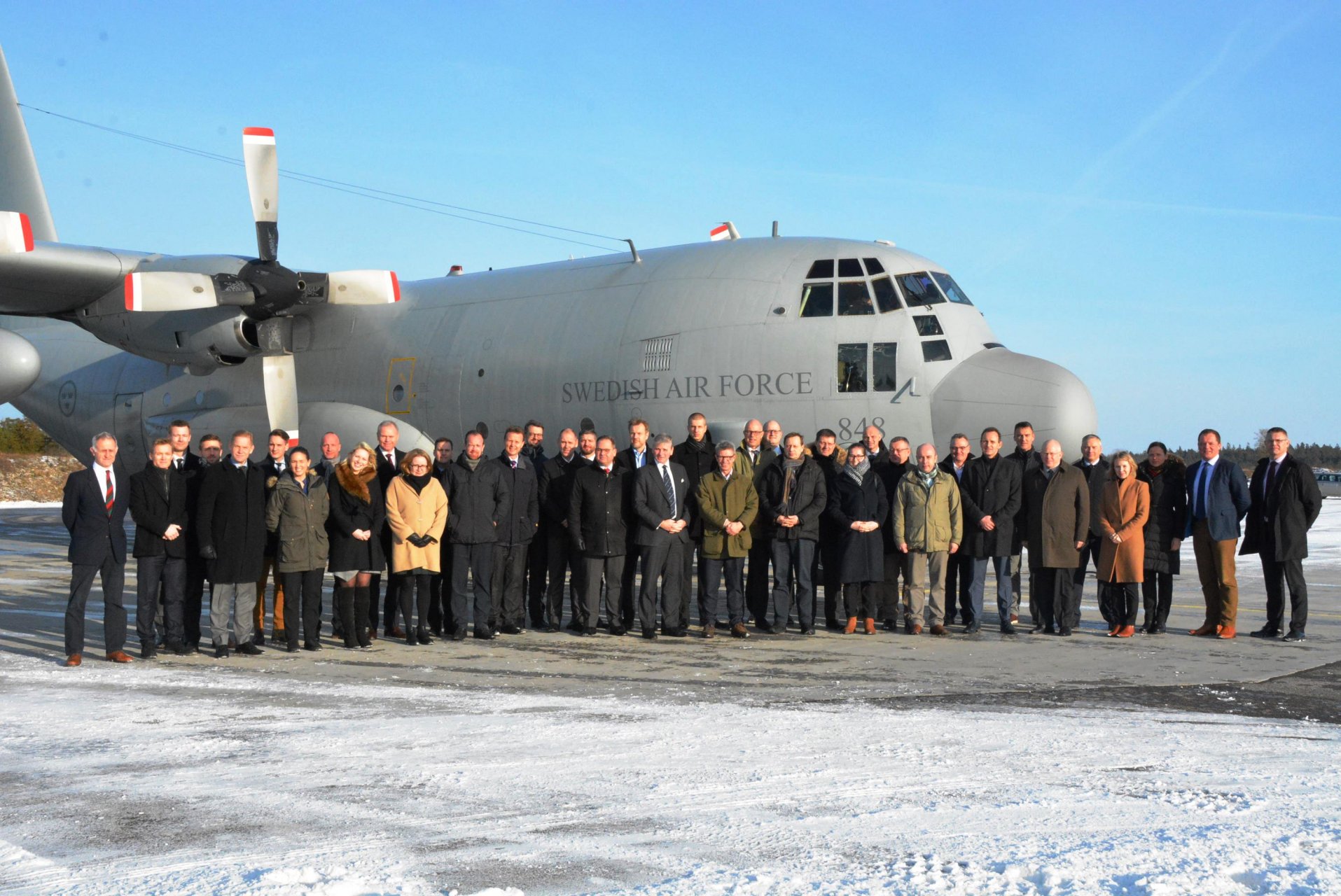
Director of the Defence Policy and Euro-Atlantic Cooperation Department of the Ministry of National Defence Saulius Gasiūnas and Deputy Chief of the Defence Staff of the Lithuanian Armed Forces Capt (Navy) Renius Pleškys took part in a meeting of military and political representatives of countries forming the United Kingdom-led Joint Expeditionary Force (JEF) held on January 23-24 in Gothland by the Swedish Armed Forces. Representatives of Denmark, Estonia, Latvia, Lithuania, the Netherlands, Norway, Finland and Sweden discussed development of the JEF in the long-term. The meeting also addressed at length employment of the JEF for enhancing security in the Baltic region, in other operations and missions, JEF exercise programme and development of the capability in general.
"The Joint Expeditionary Force is formed by like-minded nations. Our ability to work together and to take decisions swiftly on deploying the force for a common goal gives Lithuania additional security assurances. Therefore our goal is to continue being active in developing both, political and military aspects of the project," S. Gasiūnas said.
The Joint Expeditionary Force is one more capability of deterrence and defence and also a tool of strengthening security of Lithuania and the entire region and strengthening European military capabilities. "Having in mind the worsened security situation in Europe, it is important that Lithuania maintained close cooperation with the United Kingdom, especially in the context of Brexit, therefore such a rapid response force is really necessary in the current security situation," S. Gasiūnas said.
The Seimas of the Republic of Lithuania has mandated Lithuanian forces' participation in operations as part of NATO Response Force, EU Battle Groups, and the UK-led Joint Expeditionary Force, therefore in case a need arises there is legal basis in place to deploy our troops immediately thus ensuring crisis management.
According to Capt (Navy) R. Pleškys, keeping the Joint Expeditionary Force on standing readiness requires regular training and exercises. "It is an excellent opportunity for Lithuanian soldiers to refine skills alongside colleagues from the United Kingdom and other Baltic and Nordic countries taking part in the project, therefore we support and will contribute to training and exercise held in the JEF framework," he said. In early February development of the JEF will be discussed at Chiefs of Defence level, later political-level table-top exercise of Defence Ministers of the countries contributing to the JEF is planned to be held.
Representatives of Sweden also stressed the strategic importance of the island of Gothland and Sweden's consideration for the Baltic regional security.
The JEF is a brigade-sized high readiness combat unit formed to respond to emergencies in Europe and beyond: from humanitarian aid and deterrence to combat actions. The JEF is primarily meant for conduct of rapid response operations under the flag of the European Union, NATO, or the UN. Its elements could also be used for Article 5 operations.
One Lithuanian officer has been serving at the JEF operational HQ in Northwood, UK, since early 2016. A company-sized Lithuanian unit assigned to the JEF is attached to the Danish Army Battle Group, and one military medic is assigned to the UK field hospital. The Memorandum of Understanding on establishment of the JEF was signed on 30 November 2015 in London by Denmark, Estonia, UK, Latvia, Lithuania, the Netherlands, and Norway. The JEF was joined by Finland and Sweden in the summer of 2017. The final Common Memorandum of Understanding was signed by Ministers of Defence of the JEF-contributing countries in London in June 2018.
Photo: courtesy of the Swedish Armed Forces


