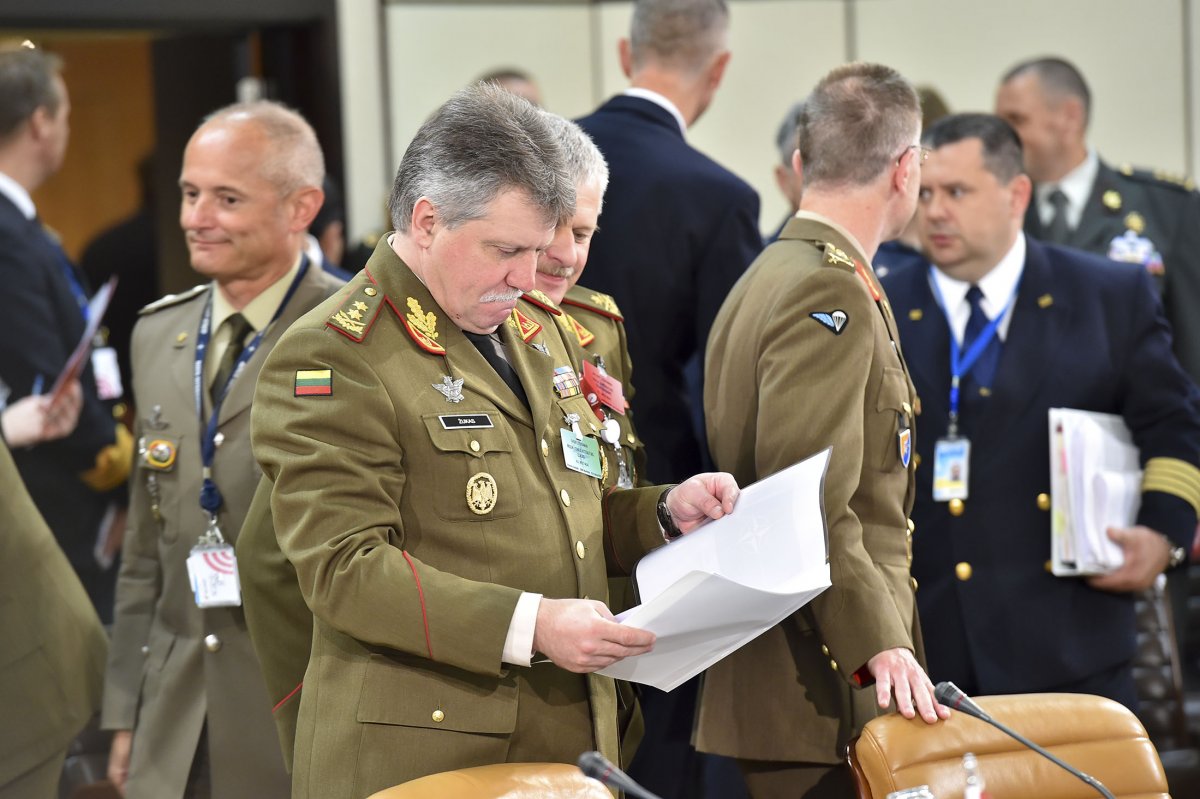
On May 20-21 NATO Military Committee (MC) addressed changes in the security situation and their implications for the Alliance, implementation of the NATO Readiness Action Plan (RAP), NATO operations, cooperation with partners, and preparations for the NATO Summit in Warsaw to be held next summer at a meeting in Brussels, Belgium.
Recently the security environment of NATO has changed in essence. The major challenges the Alliance faces comes from the East and the South. NATO must respond to this situation by reviewing its capabilities, decision-making procedures, and structure of military command. The threats of today require a more effective deterrence against hostile states, constraint of non-state actors, and defence of member states' territories and supply lines.
NATO Chief of Defence agree that the implementation of the NATO Readiness Action Plan (RAP) is fluent, which is testified by both, a fluent process of establishing the NATO Force Integration Units (NFIUs) in six eastern NATO member states, and implementation of reassurance measures.
NATO reiterates that these measures will be continued for as long as it is necessary. According to Chief of Defence of Lithuania Maj Gen Jonas Vytautas Žukas, allies are absolutely positive about the quality of the Host Nation Support and training conditions Lithuania is providing to the forces deployed as part of the reassurance measures.
With regard to the fact that the security situation is not improving, the NATO Chiefs of Defence discussed additional measures that should be taken to enhance deterrence in our region. The request to have a permanent rotating battalion-sized NATO units in each of the Baltic States which was submitted by the Chiefs of Defence of three Baltic States last week was also addressed in this context.
"NATO Supreme Allied Commander Europe General Philip Breedlove assured that our letter was received and is now under consideration, and an answer will be given in the nearest while," Lithuanian Chief of Defence said.
"The key function of the NATO Force Integration Unit in Lithuania will be to ensure that an allied reinforcement is hosted in Lithuania quickly and fluently. We will provide the infrastructure necessary for this unit as soon as this July. It is delightful that allies recognise the importance of the unit and have committed to appoint military personnel to its staff. It is planned that allied soldiers will begin service in the NFIU this August-December," Maj Gen J.V.Žukas underlined while addressing the NFIUs.
According to General, NATO should give an immediate response to threats in our region, just like in any other region. The currently formed Very High Readiness Joint Task Force (VJTF) will answer that need. The Lithuanian Armed Forces in its turn must be able to ensure that the VJTF is deployed and becomes operational in Lithuania as fluently and quickly as possible in case of necessity.
***
The NATO Military Committee is the senior NATO military structure of command reporting to the North Atlantic Council, Defence Planning Committee and Nuclear Planning Group. It makes strategic decisions and shapes military advice to the political decision-making body - the North Atlantic Council.
The Committee is formed by the NATO countries' Chiefs of Defence at the highest level, while day-to- day activities are carried out by Military Representatives. Lithuania's Military Representative to NATO and the EU is Brigadier General Gintautas Zenkevičius.
At Chiefs of Defence level the NATO Military Committee meets three times per year, twice in Brussels, and once in one of NATO member states on a rotational basis.
Spokesperson for the Chief of Defence of Lithuania Captain Mindaugas Neimontas, 00370 5 278 5091, 00370 682 25359, email: mindaugas.neimontas@mil.lt