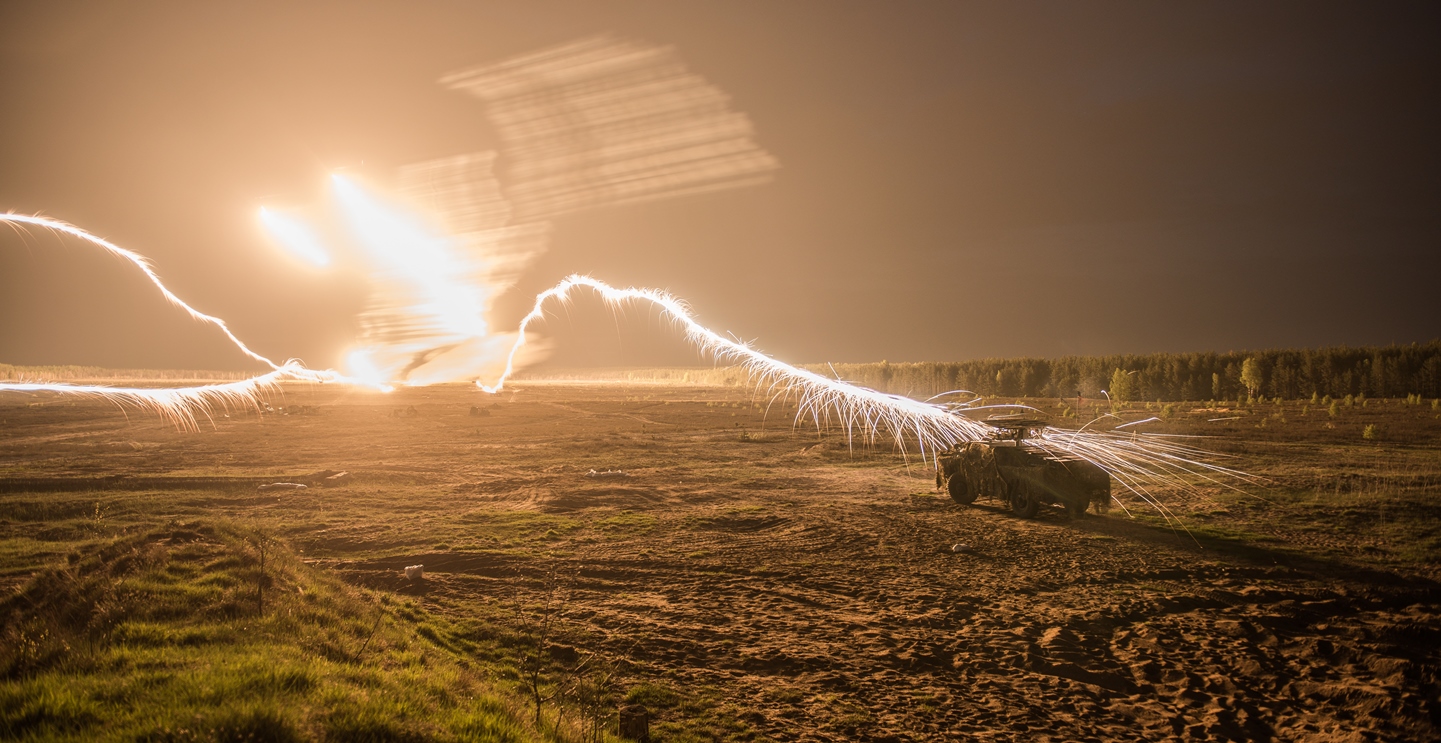
On October 6 international anti-tank live fire exercise Hunter 2017 began at the General Silvestras Žukauskas Training Area (Pabradė, Švenčionys distr.). At the exercise soldiers of the Lithuanian Land Force anti-tank units will practice live firing anti-tank weaponry, update and enhance their proficiency in anti-tank unit command and tactics, study mechanised and tank unit tactics of a potential hostile force, and share experience together with German and Norwegian infantry personnel deployed in Lithuania as the NATO enhanced Forward Presence Battle Group.
Exercise Hunter has been held since 2010 annually. This is the first year the exercise will include "force on force" training where support units equipped with grenade launchers and antitank missiles will back up infantry units practicing engaging units armed with tanks and fighting vehicles. German troops' Leopard tanks and Marder IFVs and Norwegian infantry's CV-90 IFVs will be used for simulating the hostile force actions.
Two officers of the Armed Forces of Ukraine will observe the exercise and also share Ukraine's anti-tank units' experience and tactics of fighting against armoured combat equipment of separatist forces in Eastern Ukraine.
Exercise Hunter 2017 running on October 6 through 15 trains over 600 soldiers.
The NATO enhance Forward Presence Battalion Battle Group has been deployed in Rukla since the beginning of this year. Currently, it includes over 450 German, 100 Belgian, 20 Luxembourg's, 200 Dutch and over 200 Norwegian soldiers, with Czech, Croatian, and French forces to join next year. The framework nation, also providing the biggest part of the Battle Group personnel in Lithuania is Germany. The NATO eFP is integrated into the Lithuanian Armed Forces Mechanised Infantry Brigade Iron Wolf based in Rukla and trains with it in joint exercises.
NATO Heads of State agreed to deploy the enhanced Forward Presence in the eastern part of the Alliance during the NATO Summit in Warsaw in 2016 as a response to the changed security situation. Today, there are four robust and ready multinational battle groups, in total, roughly 4.5 soldiers, in the Baltic states and Poland. Under the lead of Germany, Canada, UK, and the U.S., the multinational units are defensive and deployed along the eastern border of NATO to provide deterrence. Their deployment means that if one NATO member was attacked, the entire Alliance would respond. Another response measure to the changed security situation is augmentation of the NATO Response Force up to 40 thousand troops with the Very High Readiness Joint Task Force as the spearhead. Also, eight moderate-sized Alliance headquarters - NATO Force Integration Units are in operation.
POC - Master Sergeant Gintautas Mauricas, gintautas.mauricas@mil.lt, 00370 665 19398
Photos from Exercise Hunter 2016


