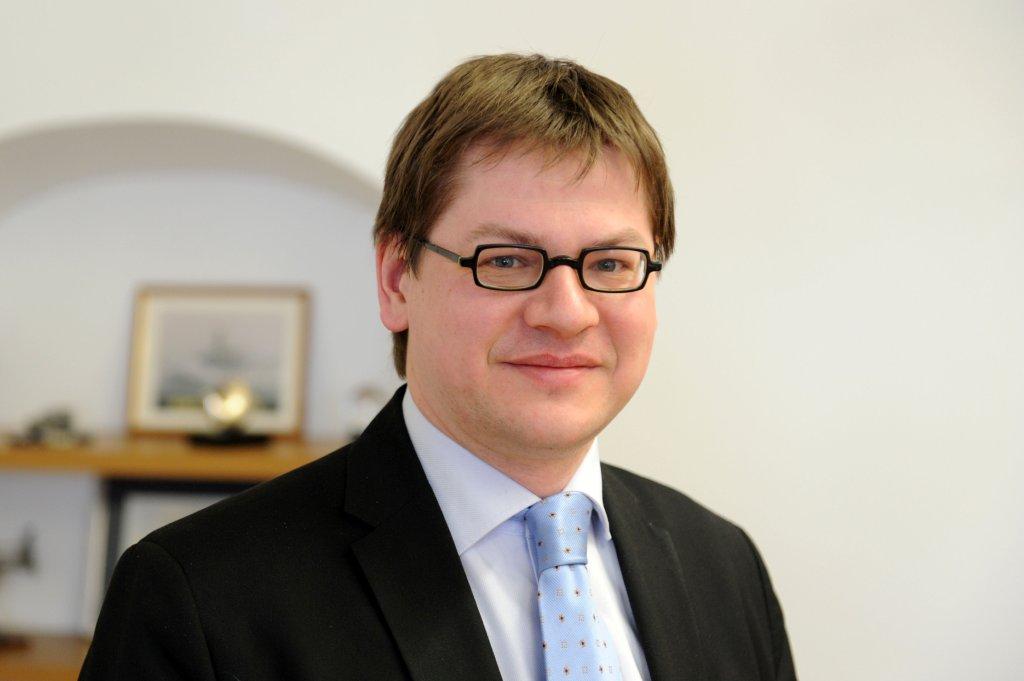
A certain hustle is felt across state administrative and political sectors of Lithuania ahead of the Presidency of the Council of the European Union (EU) that Lithuania will be holding in the second semester of 2013. Lithuania's National Defence System makes no exception. Political Director of the Ministry of National Defence Dr. Vaidotas Urbelis answers questions on a variety of defence policy-related aspects of the upcoming Presidency.
Mr Vaidotas, what will the Presidency of the Council of the European Union bring for the National Defence System?
The EU Presidency poses two principal challenges to the National Defence System. The first one, concerning subject-matter, will be put into practice at the European Council-level discussion in December 2013. Lithuania will be obliged to make a weighty contribution to determining specific ideas and proposals regarding the trends of the European defence after 2013. Despite the fact that the EU institutions responsible for the cooperation of the EU member states in defence sector were established by the Treaty of Lisbon, it has been long since the last top-level discussion regarding the EU defence principles.
Specifically, what is the content of the discussion going to be?
The first part of the debate will be dedicated to the EU response to various emerging military crises because, as the Mali intervention has demonstrated, the probability of such events will only grow in the future. The discussion over the future of the EU Battle Groups (BGs) is particularly related to the point of the EU operations too.
From the middle of 2013 Lithuania will be contributing military personnel to the standby in an EU Battlegroup formed together with the United Kingdom, Latvia, Sweden and the Netherlands. Our country has also received an invitation to join the Nordic Battlegroup. I can only underline that there are intense discussions going on in the EU right now regarding the future and applicability of the EU BGs as the units have not been invoked at least so far. A political aspect emerges here as a considerable number of politicians are questioning - why would we need to maintain the units that have been formed rather long ago but their capacity has never been put into practice? Lithuania, in joint efforts with the United Kingdom and Latvia, has prepared several proposals regarding the reorganisation of the EU BGs aimed at their increased efficiency.
The second part which is particularly important for the majority of the EU member states concerns defence industry. As it is known, defence budgets are being curtailed, global competition in defence industry is growing, new players, such as India or Brazil, are coming on stage. That throws down a huge challenge to the European defence industry. Lithuania's defence industry is not that big, however, being associated with labour market, research and technologies, it is a particularly important issue for the large member states of the EU.
The third part will be associated with the external dimension of the European Common Security and Defence Policy. We are going to discuss our activities with the EU partners, and when it comes to the Eastern partners - they are of particular importance to Lithuania. It is the cooperation with the latter that is one of Lithuania's priorities for the Presidency period, just like the overall visibility of the Common Security and Defence Policy both in the regional and international spaces. Cooperation between the EU and NATO is none the less important. Even though it is getting impeded by political reasons, the cooperation between the two organisations, comprising 21 countries as member states, is absolutely important. Therefore we just cannot afford to tolerate any competition or duplications in NATO and the EU activities.
The fourth point of importance is the defence dimension of the energy security sector: energy efficiency, security of energy resources, or employment of renewable sources. Lithuania has a certain experience in this area which needs to be availed of.
Will the events regarding the disputes you have mentioned take place in Vilnius? Will their geography be limited to the capital of Lithuania?
A portion of the events will undoubtedly be held in Vilnius, while others will take place in Brussels and other member states of the EU. In the first half of Lithuania's EU Presidency, i.e. from July to mid-October, the majority of the events will be organised in Lithuania. The EU Defence Ministers' meeting early in September will be the most relevant one to our national defence. We will also be holding workshops on the issues of energy security and the Eastern Partnership. Early in July the Political Directors of the EU countries will be convening in Vilnius.
Routine meetings as well as the already mentioned EU Defence Ministers' and the EU Political Directors' meetings may be accentuated in the list of the non-Lithuania-based events: the first one of the two is traditionally held in the country hosting the Presidency, the other one - in Brussels. Two workshops are planned to be arranged in cooperation with France and the United Kingdom in Paris and London. Organisational procedures of the majority of the events will be carried out in close coordination with the Ministry of Foreign Affairs because the EU security and defence policies cannot be isolated from one another.
Which aspects in all of the discussions on defence policy will be of greatest relevance to Lithuania? As the country holding the EU Presidency Lithuania will be able to draw them into its political agenda.
I can only emphasise once again that such aspects are the future of the EU Battlegroups and our country's Eastern Partnership with Belarus, Ukraine and Georgia where Lithuania has national interests. Energy security and NATO-EU cooperation is also among our priorities.
How will the EU Presidency affect our routine activities?
Naturally, the Presidency will be noticeable in Vilnius to the greatest extent as the majority of the events will take place here. For example, the National Art Gallery will be used as a venue for top-level meetings. Workshops and meetings of work groups will be held in various hotels and conference halls in Vilnius.
At the institutional level, additional load will be put onto many establishments of the central Government, their units will have to participate in the preparation within their scope and responsibility.
With regard to the events of the Ministry of National Defence, all the defence policy issues during Lithuania's EU Presidency will be supervised by the EU Affairs Division of the MOD Euro-Atlantic Cooperation Department. It is probable that specialists from foreign countries will join the Division's work as it is a common practice in the EU to share experience among the personnel when the Presidency rotates from one country to another. A huge workload will fall on the International Relations and Operations and Defence Policy and Planning Departments whose functions are related directly to the Eastern Partnership and energy security respectively.
We have also reinforced out team in Brussels. Formerly staffed by two people alongside the Military Representative and the Defence Advisor, now it numbers up to six - three representatives of the Lithuanian Armed Forces and three civilians. One of the team, the Defence Advisor, will chair the particularly important ATHENES work group in charge of all the financing affairs of the EU military operations.
The Protocol Division of the Ministry of National Defence is also worth mentioning. It will be contributing not only to the organisation of the ministerial events but also to the arrangement of the events of other institutions. It is not a secret that other state institutions turn for help to the Lithuanian Armed Forces when large events occur - we render as much assistance as it is possible without interrupting the process of military training.
Considering the slightly exceptional status of defence policy in the context of the European Union, will the leading officials of the National Defence System chair any of the events during this period too?
I must note here that the Treaty of Lisbon has created and established the post of High Representative. The position chairs regular meetings of the Foreign Affairs Council which are associated either to the minister of defence or the minister of foreign affairs. If such a necessity arises, the High Representative is substituted by the Minister of Defence or the Minister of Foreign Affairs of the country hosting the Presidency of the Council of the European Union. Furthermore, the present High Representative Catherine Ashton can authorise members of the Foreign Affairs Council to represent her in other events or institutions, for example, in the European Parliament.
What are your prognoses on Lithuania's preparation level for this particularly important political event?
To conclude, one may say that there is a serious challenge awaiting us. However, Lithuania has previous experience of organising or hosting important international events, for the example, NATO's Defence Ministers meeting. That allows us to feel quite confident in the face of the approaching EU Presidency. I am sure that as the host country Lithuania will manage to make a significant contribution to the EU political agenda, and that the discussions we will be initiating in the second half of 2013 will help make an advance in solving the Security and Defence Policy issues of importance to us.
Interviewer: Darius Varanavičius, Editor-in-chief of the Editorial Office of Military Serials of the Lithuanian Armed Forces
Photo by A.Pliadis (MOD)


