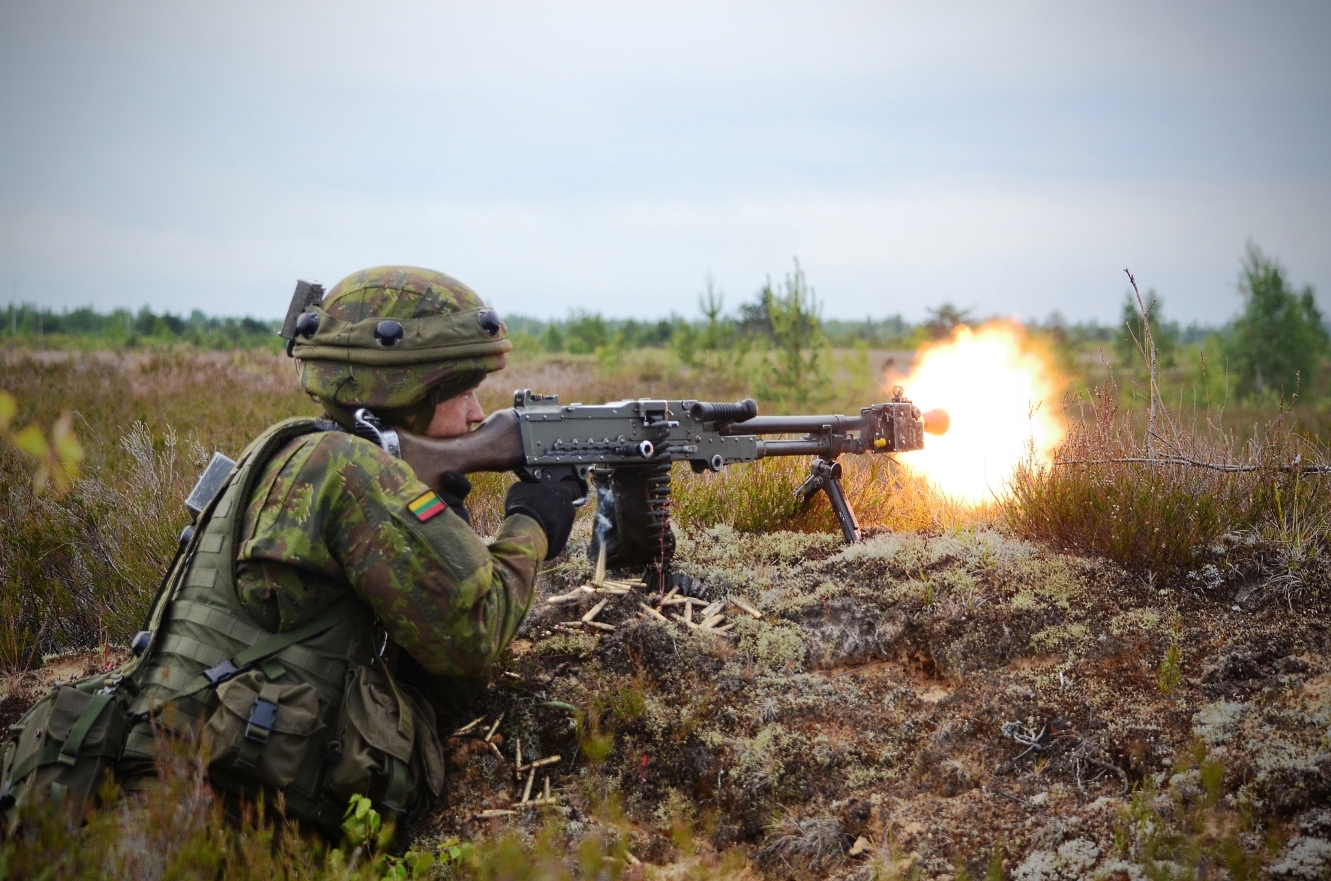
On June 18 the final day of Exercise Saber Strike 15 in Latvia the tri-national Baltic Battalion (BALTBAT) showcased its readiness for standby for the NATO Response Force (NRF) in a defensive operation. According to the exercise scenario, Estonian, Latvian and Lithuanian units comprising the Baltic Battalion were assigned to defend a territory from the opposing forces played by British, Finnish, Norwegian, and U.S. soldiers.
The portion of the international Exercise Saber Strike 15 in Latvia progressed in two phases. The first week of the exercise trained the participants to carry out hasty and planned offensive and defensive actions at company-level. The second week focussed on a battalion field training exercise (FTX) encompassing offensive and defensive operations, movement into the assembly area, tactical march, surmounting man-made obstacles, reconnaissance and others tasks. This phase also certified the Baltic Battalion (BALTBAT) for standby in the NATO Response Force (NRF) in 2016.
A team of umpires followed and assessed BALTBAT operational planning and command procedures, completion of predetermined and immediate assignments, provision of supply and communications, and other activities, and will report their conclusion to the Baltic Ministries of Defence and NATO leadership.
The Field Training Exercise of Saber Strike 15 which ran at the Adazi Training Area in Latvia as from June 8 trained the total of 1,500 troops from 7 NATO and partner nations. Allied troops trained in the exercise with their own weaponry and vehicles. Alongside with tactical planning and execution of tasks, Saber Strike 15 participants in Latvia honed interoperability and coordination of actions and exchanged experience with other nations' soldiers.
Lithuania's input into the Baltic Battalion is a company and a headquarters element of King Mindaugas Hussar Battalion, the total of roughly 1,900 soldiers. Latvia contributes a company-sized unit formed by the 2nd Battalion, Latvian Land Forces Infantry Brigade, while Estonia, the lead nation of the Battalion, assigned two company-sized units and headquarters and supply elements, is to make the total of approximately 750 soldiers from all three nations.
***
The BALTBAT project was begun with signing an establishment contract by the three Baltic nations in 1994. The Scandinavian countries and other countries of Western Europe committed to supporting the project in such areas as unit structure, manning and training, equipping and administration under the Partnership for Peace programme. With the initial operational capability reached in 1997 the battalion was ready for any peace support mission.
The first BALTBAT was in operation from 1994 till 2003. Over 700 soldiers of the Baltic countries were trained for multinational missions over this span.
Formation of the second BALTBAT began in 2007 in order to train the tri-national unit for standby for the NATO Response Force in the first semester of 2010. The unit was disbanded with the completion of the standby period.
In 2013 Baltic Chiefs of Defence agreed to reactivate the BALTBAT again for standby for the NATO response Force in 2016.
Captain Paulius Babilas, Public Information Centre Saber Strike 15, Adazi, Latvia
Photo credits: Captain Paulius Babilas (the main and 1,2,3) and Pte 1st Class Vilius Džiavečka (4, 5, 6)


