On February 24 this year the State Defence Council decided to reinstate mandatory initial military service for young people aged 19-26 for a period of five years. In fact, the draft will be of a partial nature rather than universal because a mixed model of manning the Lithuanian Armed Forces will be applied: a part of manpower will be conscript, and another - professionals. We are talking roughly 3-3.5 thousand recruits per year with roughly 200 thousand potential conscripts available in the country.
The decision is yet to be approved or rejected as a matter of urgency at the Parliament of the Republic of Lithuania.
A decision concerning imposition of national service will never be popular and will never be met by the society unambiguously positively. It is natural that various discussions have flared up and speculations have been fuelled about the mandatory military service in the society and among politicians.
As I have been following the developing situation, I noticed that essentially there are little doubts about the changed geopolitical and security situation, and most people realistically recognise that the threat to our country is, it is true to say, here at the gates. I have spotted the greatest concentration of doubt regarding such points as competence of conscripts, imposition of a military duty in a democratic country, the way the message has been conveyed, transparency of conscription, and such. I think we have found answers to many of these questions while pointing out to those seeking additional information to where it may be found. In case we are reintroducing conscription, we will do our best not only to provide for volunteers or those called up on the basis of the mandatory order as favourable service conditions as possible but also to ensure as wide range of social securities as possible so that their personal and public interests do not suffer and they are properly rewarded with exemptions and incentives after the service.
I would like to assure potential conscripts that their concern and doubts are natural and their true cause is uncertainty. It is natural that young people are anxious about whether they succeed in adaping to a new group, getting used to army order and discipline and a strict day's routine. About whether they are able to take physical and psychological load. But trust me, I know it from my own experience that such feeling will not last. In most of the cases it will take only several months in service to reach a certain breaking point, and then a bit different approach will develop in you. The service will bring about positive emotions which will stay there for the rest of your lives. Moreover, I dare to call military service a school of noble values. Graduates will love their country more, will be braver and more self-confident people. Also, you will have developed more respect for both, yourselves and the people around you, and will have learned to work in a team. I have absolutely no doubt that this is going to help you a lot in your future lives, no matter what path you will choose.
We have arrived at the decision to reinstate mandatory initial military service gradually
I wish to highlight that we were moving towards the decision to reintroduce conscription gradually as we were learning Ukraine's lessons. We have learned quite a number of them and improved ourselves already, therefore it would really be a shame if we failed to learn the lesson of manning the armed forces and training the reserve.
The example of Ukraine has proved once again that units of regular armed forces must be manned and provided with equipment as fully as possible. It is not enough to declare that we have many units. We ought not to try to deceive ourselves and others for sooner or later there will come the day when we need to take a realistic view of the combat power of our armed forces. Besides, it is vital to have a sufficient trained reserve, i.e. at least three times as big as the regular armed forces, which could be available at short notice and could be sent into combat without additional training.
I was aware of the situation in the Lithuanian Armed Forces before I was appointed Chief of Defence last summer. I knew our infantry battalions are insufficiently manned, only two battalions exceeded 50% when minimum operational requirement is at least 70%. Even back then I was making public statements that the situation in manning the armed forces with professionals needed to be improved. As time went by, it became clear that no agitation would help voluntarily enlist the planned additional 450 soldiers annually with the payment and package of social guarantees offered.
Furthermore, it was evident that training of the reserve was of a particularly small scope and could not ensure a proper level of state security. The size of reserve is 70-80 thousand, however, I take it as a theoretical assumption. It is not clear where these people are, what their training level is, we also do not know whether we are able to call them up in case of mobilisation, etc. I am inclined to take a more realistic approach, that is, I can only be sure that the trained reserve, the members of reserve who are trained relatively freshly and their military knowledge and skills have not faded yet, would be at my command in case of necessity. And today we have only roughly 2.5 thousand of those.
In my view, a partial reintroduction of the mandatory military service is the best solution in light of the situation that we have today within and outside our country. We are looking into various other means to sort this out in a more liberal way, however, there would be no guarantee of success , plus it might take very long to implement them.
Calling up for and arranging mandatory initial military service will not strike us as something new, we are experienced enough in that. The result we achieved till 2008 also proves my words: roughly 80% of draftees choose to continue a professional military career. Had we achieved this result at least partly, we would be able to draw the needed number of professional soldiers into the Lithuanian Armed Forces within several years and could amass roughly 15 thousand-strong trained reserve capable of ensuring national defence immediately, i.e. not requiring supplementary training.
The five Ukraine lessons we have already learned
Lesson 1. The hybrid warfare in Ukraine has demonstrated that a split-second response with adequate military means must be given to unconventional threats ahead of introducing the state of war. Obviously, certain military capabilities and an authorisation to use them in full must be in place to do that.
We have learned this lesson. On 16 December 2014 the Parliament endorsed the new Statute on the Use of Armed Force proposed by the Ministry of National Defence as a matter of urgency. It paved the way for using armed forces in peacetime immediately to respond to unconventional threats which do not amount to a case of an armed aggression by their nature, for example, to provocative campaigns, assaults of armed groups, or armed people crossing the state border illegally, etc.
We have formed a national quick response force so we could give an adequate and immediate response to the abovementioned threats. Two battalion tactical groups with air, special operations and logistic support elements incorporated and ready to respond within 2-24 hours are on a permanent standby since November 2014.
Lesson 2. Hybrid conflict increases the importance of interaction among power structures of the state. The Lithuanian Armed Forces realises that and is cooperating with structural units of the Ministry of the Interior (the Police Department, the State Border Guard Service, the Fire and Rescue Department, the Public Security Service, and the VIP Protection Department) increasingly tighter. We are already exchanging intelligence with our colleagues, training successfully together, studying each other's capacities and functions relevant for national defence, improving legal basis, activity procedures, and so on.
Lesson 3. If we mean to maintain a proper level of readiness of the Armed Forces, weaponry and military materiel have to be constantly updated with a focus on reconnaissance, anti-tank, air defence and fire support capabilities. I believe, every military understands that being in an up-to-date shape is what it should seek, however, most often that is prevented by a lack of financing, and a bit less often - by a lack of military and political will. I would classify Lithuania's case as a shortage of financing. As it is known, defence financing has reached the level of 2008 again only this year, whereas there is still a way to go to 2%, the minimal NATO standard. Such a situation determines our defence procurement - we are only making the top priority acquisitions. The recently bought FN SCAR marksman rifles, the GROM man-portable air-defence systems, and also the plans for acquiring anti-tank weaponry, self-propelled artillery systems, infantry fighting vehicles, modernisation of the present mortar systems, and others, are all a very welcome step ahead that is increasing the strength of our capabilities, even though not at the pace we would like to see.
Lesson 4. In case of an armed conflict success on the ground is heavily influenced by the success in information space. The armed forces must necessarily ensure that the society receives unbiased information both from its armed forces and the media. Capabilities for ensuring information security, cyber defence, strategic communication and counterpropaganda are also critical for the military.
We have already made quite some progress in this area. The National Cyber Defence Centre has been established to ensure monitoring and management of cyber incidents concerning vital infrastructure and information resources, and for planning of information infrastructure defence. Strategic communications capacity of the national defence system is being increased, the Strategic Communication Department of the Lithuanian Armed Forces is constantly monitoring and analysing the information space and offering its assessment and advice on possible counteraction. The Lithuanian Riflemen's Union, a specific military unit - the Non-kinetic Operations Company of the National Defence Volunteer Force, various friends of the Lithuanian Armed Forces and media are also actively involved in the fight in the information space.
Lesson 5. The society has to be properly prepared for actions in case of war. We are really active in this area. As you know, early this year the Ministry of National Defence has issued a called Things to Know about Readiness for Emergencies and War publication for the general public. It evoked great response and earned great popularity. A joint mobilisation and civil resistance system is being developed, various means and ways are used to boost the feelings of patriotism and citizenship in the society, to spread information about the Lithuanian Armed Forces and about opportunities to undergo military training. We are open to our society and ready to help to the greatest extent possible.
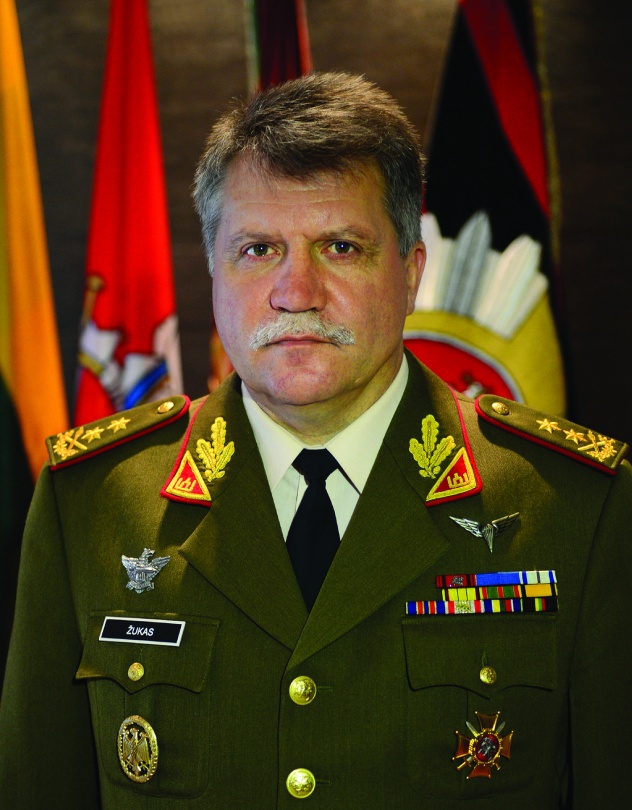
Major General Jonas Vytautas Žukas
Chief of Defence of Lithuania


